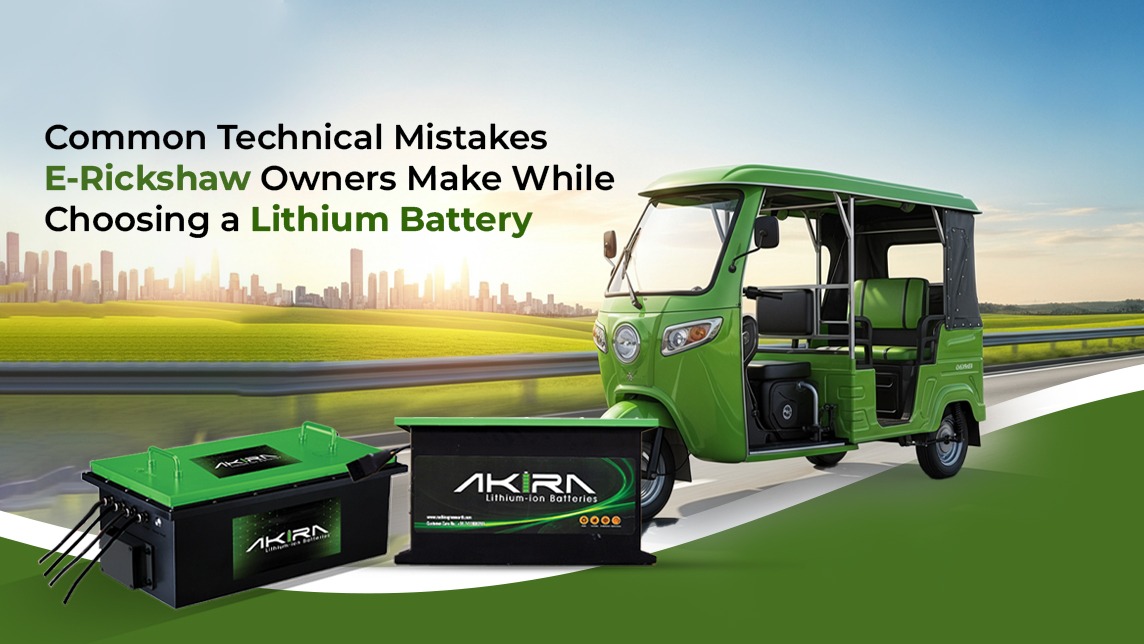
Common Technical Mistakes E-Rickshaw Owners Make While Choosing a Lithium Battery

In the e-rickshaw business, battery problems rarely appear overnight. They build quietly. A little voltage instability here. A bit of heating there. Then one day, range drops, controllers fail, or the battery simply refuses to hold charge. In most cases, the root cause isn’t usage, it’s selection.

Choosing the wrong lithium ion battery for e rickshaw from a technical standpoint is one of the costliest mistakes operators make. And unfortunately, it’s far more common than it should be.

1. Matching Nominal Voltage Without Studying Load Behaviour

On paper, voltage looks simple. In reality, it isn’t. Many batteries show the correct nominal voltage but collapse under real driving loads. That collapse stresses motor controllers and slowly damages internal components.

A properly engineered lithium ion battery for e rickshaw must hold voltage steady during acceleration, inclines, and stop-start traffic.

AKIRA batteries are designed to deliver controlled voltage behavior, not just a printed number on a label.

2. Confusing Capacity With Power Delivery

Capacity (Ah) is easy to sell. Power delivery is harder to explain and often ignored. When a battery is unable to deliver sufficient current during peak demand, voltage sag occurs. The rickshaw feels sluggish, heats up, and e-rickshaw battery drains faster than expected leading to reducing the life span of the battery.

AKIRA batteries are built with balanced discharge characteristics. That balance allows the lithium ion battery for e rickshaw to deliver power smoothly, even during continuous commercial use, without stressing the cells.

3. Ignoring Thermal Design in E-Rickshaw Lithium Batteries

Heat is the slowest, quietest battery killer. Poor thermal design doesn’t always cause immediate failure. Instead, it shortens battery life month by month.

AKIRA integrates thermal stability into the battery structure itself. Heat disperses evenly, temperatures remain controlled, and cell degradation slows dramatically. As a result, the lithium ion battery for e rickshaw performs consistently across long working hours and high ambient conditions.

4. Assuming All BMS Systems Are “Good Enough”

A weak Battery Management System doesn’t fail loudly. It fails silently, through poor cell balancing, delayed protection, and inaccurate charge readings.

AKIRA batteries use intelligent BMS logic that actively monitors voltage, current, and temperature at the cell level. This allows each lithium ion battery for e rickshaw to protect itself in real time, rather than reacting after damage has begun.

5. Using Unsuitable Lithium Cell Chemistry

Not every lithium chemistry belongs in a commercial EV. Some degrade quickly under repeated high-load cycles. Others lose stability when pushed daily.

AKIRA selects lithium chemistry specifically suited for e-rickshaw duty cycles. This ensures the lithium ion battery for e rickshaw maintains structural stability, predictable performance, and long service life under real operating conditions.

Why AKIRA Batteries Perform Reliably in the Field

AKIRA batteries are engineered around actual e-rickshaw usage, not lab assumptions. Voltage regulation, discharge capability, thermal control, and BMS intelligence work together as a single system. That systems approach is what delivers reliability, safety, and long-term value.

This engineering approach has been validated across diverse operating conditions and daily commercial usage.

Conclusion

Technical mistakes during battery selection rarely look serious at first. Yet over time, they reduce earnings, increase downtime, and raise replacement costs. Choosing a properly engineered lithium ion battery for e rickshaw eliminates these risks at the design level. AKIRA Batteries address the technical realities of commercial EV operation, making them a dependable choice for operators who value performance and longevity.

Avoid costly technical mistakes when choosing a battery for an e rickshaw. See how AKIRA Batteries ensure stable performance and longer life.

FAQs

Q1. Can poor thermal design reduce battery life without warning signs?

Yes. Heat accelerates internal degradation long before failure becomes visible.

Q2. Does BMS quality really affect daily driving?

Absolutely. A strong BMS ensures safety, balance, and accurate performance tracking.

Q3. Are AKIRA batteries suitable for high-usage e-rickshaws?

Yes. AKIRA batteries are engineered for continuous, high-load commercial operation.

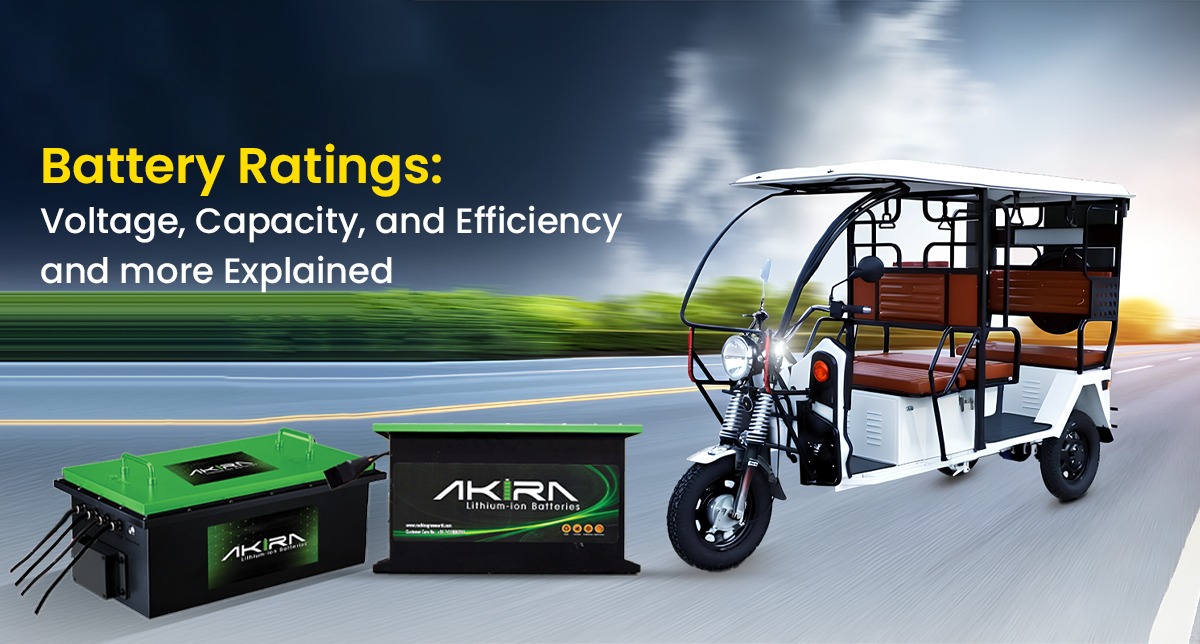
Battery Ratings: Voltage, Capacity, and Efficiency and more Explained

12V, 100 Ah or 80% DOD. Have you come across these terms? Must have. But you must not have paid much attention to it. These are the terms we see on the batteries. Be it lead acid or lithium ion batteries. These are very important terms. That tells us about how strong the battery is and how long they can work. Learning about these terms is important to be a well informed consumer. In this blog, from Akira, a reliable Lithium ion battery manufacturer in India, let us understand these terms in detail.

1. Voltage

Voltage is how strong a battery pushes electricity. Imagine water pressure in a pipe—the more pressure, the faster it flows. Big machines need bigger volts, small gadgets need less. Voltage shows what a battery can handle.

2. Capacity

Capacity basically shows how long a battery can keep going. Measured in Ah, a 100Ah battery can give 1 amp for 100 hours—or 10 amps for 10 hours. Bigger capacity means longer power, kind of like a big water tank—super handy for inverters or solar systems!

3. Efficiency

Efficiency basically tells us how much energy from a battery we can actually use. As we know, some energy is always kind of lost as heat, so no battery ever gives a full 100%. But, a battery with 90% efficiency gives back most of its power, which is really great! At Akira, a dependable Lithium ion battery manufacturer in India, we make sure our batteries use energy super smartly, so they last longer and basically keep you powered up without any worries!

4. BMS

BMS or Battery Management System, is like a battery’s helper. It keeps your battery safe and healthy. It makes sure the battery doesn’t get too hot or too full. The BMS helps the battery work better.

5. Discharge

Discharge is when the battery gives out its energy to run devices, like water flowing out of a tank to fill cups.

6. DOD

Depth of Discharge (DOD) shows how much energy a battery has used. If a battery is full and you use half, then the DOD which is a short form of Depth of discharge is 50%. Keeping DOD low makes the battery last longer.

7. Cycle Life

Cycle life is how many times a battery can be charged before it starts losing power. The more cycles, for the longer time the battery lasts.

8. Self-Discharge

Self-discharge is when a battery loses a little energy even if it isn’t being used. Some energy disappears over time, like a leaky water bottle.

Why Battery Ratings Are Important

Knowing voltage, capacity, and efficiency is like having a battery superpower! Big machines need batteries with a strong “push” (more voltage), while tiny gadgets are happy with a smaller push. Capacity shows how long your battery can keep going, and efficiency makes sure none of its energy goes to waste!

Akira Batteries: Power You Can Trust

At Akira, a trusted Lithium ion battery manufacturer in India, every battery is made to have the perfect mix of voltage, capacity, and efficiency. Our batteries are strong, long-lasting. They work great for home inverters, solar panels, or big machines, giving power you can trust.

Conclusion

Learning about battery ratings makes picking the right battery simple! Voltage shows the battery’s strength, capacity tells how long it can last, and efficiency shows how well it works. With Akira, one of the trusted Lithium ion battery manufacturers in India, every charge is strong and useful!

How Akira Lithium-Ion Batteries Are Changing E-Rickshaw Rides in India

Let’s deep dive into how Akira Lithium-Ion Batteries Are Revolutionizing E-Rickshaw games in India!!

Electric rickshaws are rapidly turning into a preferred mode of transport on roads all over India. Getting a smooth ride and reliable performance relies primarily on a single factor—the battery of the E-rickshaw,

Akira Lithium-Ion batteries for E-rickshaw have successfully and efficiently provided for those requirements.Making it easier for both passenger as well as E-rickshaw operators.

Problems Encountered by E-Rickshaw Drivers In India

Handling the wheel and being in charge of an E-rickshaw is not easy in India. E-Rickshaw drivers need to confront a number of challenges from pot holes on the roads to the resulting congestion of cars, trucks and auto rickshaws and unpredictable weather. The summer is hot and humid and the monsoon season brings heavy rains and muddy..

Under these conditions, it is really a challenge and test of patience and endurance to drive and operate the E-riskshaw under each of these distinct weather conditions.

Dusty winds will destroy the battery system. While conventional lead-acid batteries can function in such an environment, Akira Lithium-Ion E-rickshaw Batteries are designed to run in fluctuating conditions across India – rain or shine, dust, or heat, our batteries are designed to get the job done.

What Makes Akira Batteries Special

Akira E-Rickshaw batteries aren’t only about power — they’re designed for better performance.

Akira batteries not only offer high-power batteries; but trust, reliableability, They have been engineered to function in real-world conditions. Some of the important features of Akira E-Rickshaw batteries includes,

  • Reliable: The batteries deliver reliable power from beginning to end for longer rides, providing reliability of performance
  • Weather-tough: Between hot summer weather and rainy monsoons, Akira batteries keep delivering consistent performance.
  • Long Lasting, Less frequent Maintenance: Thousands of charges mean fewer replacements and less hassle.
  • Safety: Overcharge protection, short circuit protection, and temperature check provide safety.

All these reasons make Akira Lithium-Ion Batteries to be reliable battery partners for all e-rickshaw operators out there.

Benefits to E-Rickshaw Drivers

Switching to Akira Lithium ion battery for E-rickshaw batteries provides numerous advantages, some of those are highlighted here ;

  • Reduced Downtime: Quick recharging and longer life put e-rickshaws in operation for more time.
  • Reduced Maintenance Expense: Reduced replacement and maintenance save them money.
  • Efficiency: Lighter construction improves vehicle performance.
  •  Environment friendly: Lithium-ion technology is cleaner and less polluting than traditional batteries.

Operators can run their business at full capacity. This, in turn, allows them to provide smooth rides for passengers as well.

Innovation & Research

Akira’s Research & Development team together with the technical team  works hard to enhance battery performance, safety, and lifespan. Innovation focus enables it to remain competitive in the Indian e-rickshaw battery industry. Every battery is tested under real conditions. This ensures that it can meet the driver’s  daily requirements.and to help with their hustle. 

Conclusion

Akira Lithium-Ion E-rickshaws batteries in India beyond transportation. They are trustworthy. The batteries provide stable performance, require less frequent maintenance, and last long. This simplifies daily travel, makes it safer, and more rewarding. 

For emerging electric mobility, India has an emerging leader in Akira Lithium ion E-Rishakshaw battery manufacturers. They support drivers in realizing optimal e-rickshaw experience.

Choose Today Akira Batteries for reliable, efficient, and trouble-free transportation—every single day.

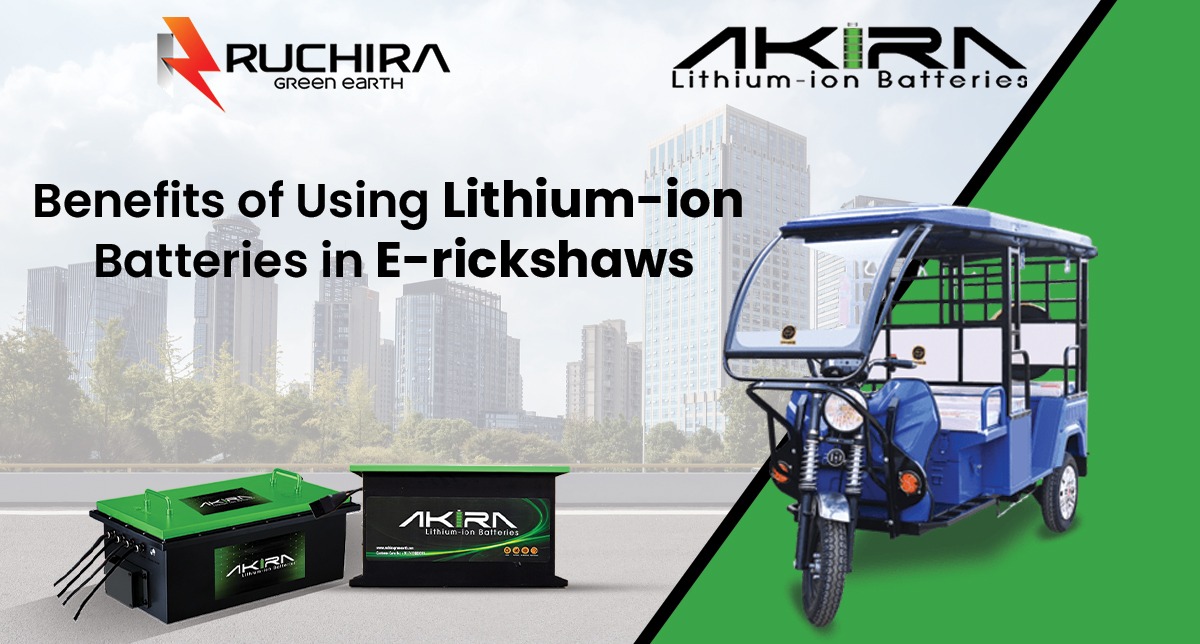
Top 7 Benefits of Using Lithium-ion Batteries in E-rickshaws

With growing times, the electric mobility wave is accelerating rapidly in India. And at the core of this change lithium-ion batteries in E-rickshaws are playing a major role. For both drivers and fleet owners, upgrading to lithium power is not just a trend — but it’s a game-changing move that boosts performance, savings, and sustainability.

Let’s discover the top 7 benefits of using lithium-ion batteries in E-rickshaw and how Akira is taking charge in this transformation.

1. Longer Battery Life

Lithium-ion batteries last longer, usually more than 5 years, significantly longer than any traditional lead-acid batteries. This extends the lifespan of the battery, which means fewer replacements and better long-term savings.

2. Faster Charging

In the life of an E-rickshaw driver time is a crucial part. For them, time is equal to money. Aligning with their needs Lithium-ion batteries can be charged 3-4 times faster than any other lead-acid batteries, which means more trips, more passengers, and more daily income. 

3. Lightweight Design

Weight matters, especially for three-wheelers. Lithium-ion batteries are far lighter than their counterparts, which improves vehicle range and reduces wear and tear on components.

4. Higher Efficiency & Range

With better energy density, lithium batteries deliver longer rides per charge. Whether it’s city commuting or rural trips, you can count on more kilometers and less downtime.

5. Low Maintenance

With lithium-ion batteries, you don’t need to take the stress of regular water top-ups or acid spills. These require very minimal maintenance, making batteries a priority choice for busy drivers.

6 Eco-Friendly and Built for Safety

When you choose a lithium-ion battery, you’re not just powering your E-rickshaw — you’re doing your bit for the planet too. These batteries are cleaner, greener, and fully recyclable, which leads to less pollution and a smaller carbon footprint.

And when it is about safety, modern lithium batteries are always ready to back you. With smart features like BMS (Battery Management System), they automatically prevent overcharging, overheating, and other common issues — so you can drive with confidence, knowing you’re in safe hands.

7. Cost-Effective in the Long Run

However, the cost at initial stages may be higher but after installation lithium-ion batteries offer a better and substantiate returns on investment done. With the smarter features of lower maintenance, faster charging and long life, it leads to significant savings over the time. 

Why Choose Akira Lithium Batteries?

Along with all this Akira offers an advanced, more reliable and a durable lithium battery solution specifically tailored for the Indian E-rickshaw market. If you’re searching for a Three wheeler lithium battery India that performs in all weather, terrain, and load conditions — Akira is the name to trust.

Akira Batteries are designed with the cutting edge technology, which is backed by excellent after-sales support and are powering E-rickshaws already around the corners of India. 

Conclusion

Switching to lithium-ion batteries leads to better business more than about better batteries. Your E-rickshaw gets transformed with a better and smarter power, which lasts longer and gets more savings. 

Ready to power your ride the Akira way?

Choose Akira – the trusted name in Three wheeler lithium battery India. 

Contact us today for a quote or dealership opportunity and drive into the future with confidence

Signs Your E-Rickshaw Battery Needs Replacement & What to Do

E-rickshaws have become the lifeline of sustainable last-mile transport across many Indian towns and cities. They are eco-friendly, cost-effective, and widely used by daily commuters. However, at the core of every smooth-running E-rickshaw lies one crucial component—the battery. And like all things mechanical, batteries come with a shelf life. Over time, even the most advanced batteries lose efficiency, directly affecting your vehicle’s performance, range, and profitability.

So, how do you know when it’s time to change your battery? Recognizing the signs early can save you from unwanted breakdowns, lost income, and even safety hazards. In this blog, we’ll walk you through the most common signs your E-rickshaw battery needs replacement—and what steps to take next. Whether you’re an individual owner, a fleet operator, or a dealer, having the support of a reliable lithium-ion E-rickshaw battery manufacturer can make a world of difference.

1. Decreased Backup Time

If your E-rickshaw used to give you 80–100 km per charge but now struggles to complete even 40–50 km, your battery could be wearing out. This is often the first and most visible sign of battery degradation. Reduced backup time can drastically impact your earnings if your vehicle cannot complete a full day’s shift.

2. Longer Charging Time

Charging that once took 3–4 hours now drags on for 6–7 hours? That’s a problem. Lithium-ion batteries are known for their efficient charging cycles, and when they begin to slow down, it’s a clear indicator that internal components have degraded. Longer charging times also reduce the number of trips you can complete in a day.

3. Frequent Need for Charging

Is your charger plugged in more often than your vehicle is on the road? Batteries with reduced capacity require more frequent charging. This affects operational uptime, causes unnecessary delays, and eats into your productivity. It’s time to speak with a lithium-ion E-rickshaw battery manufacturer about a performance upgrade.

4. Overheating Issues

Overheating during charging or discharging is a serious warning sign. It can be caused by internal short circuits, damaged cells, or battery mismanagement. If you notice a swollen battery casing, odd smells, or high external temperatures, stop usage immediately and consult a technician. Overheating is not just a performance issue—it’s a safety concern.

5. Dashboard Warnings or Fluctuating Indicator

Most lithium-ion E-rickshaw batteries come with a Battery Management System (BMS). If your dashboard shows fluctuating charge levels, error symbols, or warning lights, there may be a fault in the battery pack. Ignoring these alerts can lead to sudden failure.

What to Do Next?

Stop using the faulty battery to avoid further damage or safety risks.
Consult a trusted lithium-ion E-rickshaw battery manufacturer for an expert assessment.
Choose a replacement battery based on your E-rickshaw’s voltage and operational demands.

When picking a new battery, always consider:

Charging speed and cycle life
Warranty and after-sales service
Battery weight and fitment
Support from a reputed lithium-ion E-rickshaw battery manufacturer

By choosing a reliable partner, you ensure higher performance, reduced breakdowns, and long-term savings.

Conclusion

Your battery is not just a component—it’s the lifeline of your E-rickshaw. Don’t wait for a total breakdown to take action. Reduced backup, longer charging, or overheating are all clear signs it’s time for a replacement. Always rely on an expert lithium-ion E-rickshaw battery manufacturer to get the right battery for your needs—built for Indian roads, heavy use, and long journeys.

Power up smart. Ride worry-free.