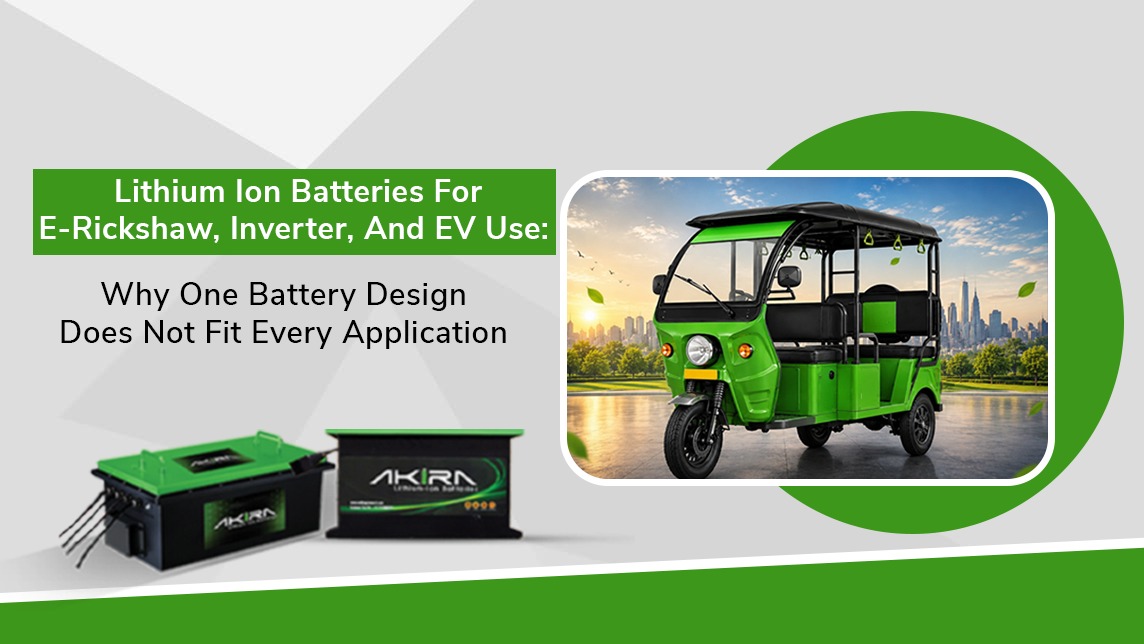
A lithium battery may look like one product from outside.
Same box, voltage label and the same old promise of long life and fast charging.
But in real use, every battery does not do the same job. A battery used in an e-rickshaw works differently from one used in an inverter. An electric scooter battery also has a different load pattern.
That is why one battery design cannot fit every application.
Akira, a Lithium ion battery manufacturers in India works across different lithium battery applications, including e-scooters, e-rickshaws, e-autos, inverter backup, telecom, solar, and ESS. Because of this, battery selection should start with the actual use, not just voltage and Ah rating.
E-Rickshaw Batteries Need Load Handling
An e-rickshaw battery has a hard job.
It carries passengers, runs for long hours, faces traffic, uneven roads, slopes, heat, and daily commercial use. The driver depends on the battery for income, so weak performance directly affects earning.
A lithium ion battery for e rickshaw should hold voltage properly under load. If voltage drops too much during acceleration or passenger load, the rickshaw feels weak. Range also drops faster.
So, e-rickshaw batteries need strong discharge support, thermal control, stable output, and long cycle life. Capacity matters, but it is not the only thing. The battery should match the motor, controller, vehicle weight, passenger load, and daily route.
Inverter Batteries Need Stable Backup
An inverter battery has a different role.
It does not face road vibration or acceleration load. Instead, it has to give steady backup during power cuts.
A lithium ion battery for inverter should support safe charging, stable discharge, and proper inverter compatibility. In homes, it may run lights, fans, Wi-Fi, TV, or small appliances. In shops and offices, it may support computers, CCTV, billing machines, and basic systems.
However, problems start when the battery is not matched properly. If the inverter charging profile is wrong, the battery may undercharge or overcharge. If the connected load is too high, backup drops quickly.
For inverter use, the main focus should be backup stability, BMS protection, charging compatibility, and long usable life.
EV Batteries Need Compact Power And Safety
EV batteries, especially for scooters and two-wheelers, need quick response.
They must fit in limited space, stay lightweight. And they also need to support acceleration, rider load, heat, road vibration, and daily charging.
A scooter rider notices battery problems quickly. If the battery heats up, range drops, or the pack cuts off suddenly, the ride gets disturbed.
Because of this, EV batteries need proper cell matching, compact pack design, BMS safety, thermal handling, and charger compatibility.
This is where experienced lithium ion battery manufacturers in India matter. A scooter battery, e-rickshaw battery, and inverter battery all need different design priorities.
BMS Settings Change With Application
BMS is not just a protection board.
It controls how the battery behaves during charging and discharge. For an e-rickshaw, the BMS must handle heavy load and long working hours. And an inverter, it must support steady backup. Last for a scooter, it must manage compact power delivery, heat, and sudden load changes.
If the BMS does not match the application, issues can appear later. The battery may cut off early, heat up, charge poorly, or give uneven performance.
So, when comparing lithium ion battery suppliers in India, buyers should ask one simple question:
Is this battery designed for my application, or is it just a general lithium pack?
That answer matters.
Why Application-Wise Battery Selection Matters
Lithium batteries are not one-size-fits-all.
An e-rickshaw needs load handling. An inverter needs stable backup. An EV needs compact power delivery and safety.
The chemistry may be lithium, but the design has to match the job.
Akira’s wide application range helps buyers choose batteries based on actual use instead of guesswork. For e-rickshaw owners, inverter users, dealers, OEMs, and businesses, this makes a real difference.
A well-matched battery works quietly in the background.
A wrongly matched battery becomes a regular complaint.
Final Thoughts
The right lithium battery is not selected only by voltage and Ah rating.
It depends on where the battery will be used, how much load it will handle, how often it will charge, and what kind of performance the user expects.
That is why buyers should work with experienced lithium ion battery manufacturers in India who understand different battery applications.
Because in real use, the best battery is not the one that only looks good on paper.
It is the one that fits the job properly.