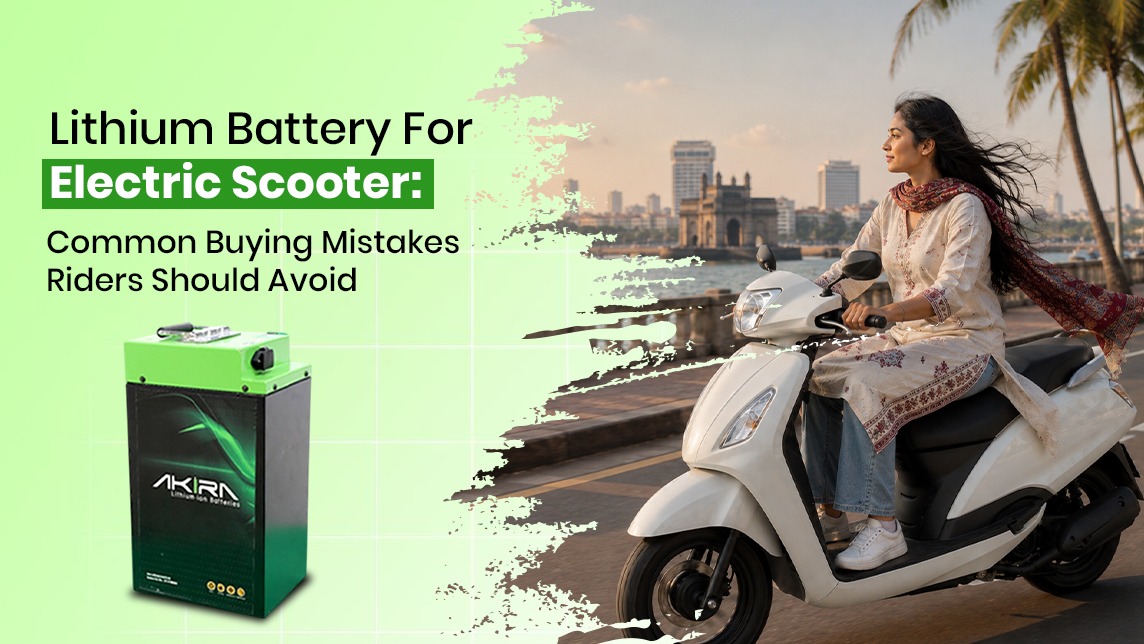
Buying a lithium battery for electric scooter looks simple until the wrong battery starts creating problems.
At first, everything may seem fine. The scooter runs. Charging happens. Range looks okay. But after a few weeks or months, small issues start coming up.
Range drops faster than expected. Battery heats during charging. The scooter feels weak with load. The charger does not match properly. The battery cuts off suddenly.
Most of these problems do not happen because lithium battery technology is bad. They happen because the battery was not selected properly.
The company Akira provides e-scooter lithium batteries in various voltages and capacities, such as 48V, 60V, and 72V models. Other features included in the series include longevity, light weight, safety, quick charging capability, compactness, customization, minimal self-discharge, environmentally friendly construction, and GPS compatibility.
But even with a good product range, the battery must match the scooter and the rider’s usage. That is where many buyers make mistakes.
Mistake 1: Buying Only By Voltage
Many buyers think if the voltage matches, the battery is correct.
That is only half true.
Yes, voltage matters. A 48V scooter needs a 48V battery. A 60V scooter needs a 60V battery. A 72V scooter needs a 72V battery.
But voltage alone does not decide performance.
Two 60V batteries can behave very differently under load. One may hold voltage properly during acceleration. Another may drop quickly when the scooter carries two people or climbs a slope.
So do not buy only because the sticker says the right voltage. Check capacity, discharge support, BMS quality, charger matching, and scooter load requirement too.
Mistake 2: Ignoring Daily Riding Pattern
A rider using the scooter for nearby market runs does not need the same battery as someone doing delivery work all day.
This is where many wrong purchases happen.
Some buyers choose a lower-capacity battery because it costs less. That may work for short rides. But if the scooter runs long routes daily, the battery gets deeply discharged again and again. That reduces life.
For regular riders, delivery users, shop owners, and commercial two-wheeler users, battery selection should depend on daily range, load, road condition, and charging time.
The right battery is not always the biggest one. It is the one that fits your actual use.
Mistake 3: Not Checking Battery Size And Fitment
A battery may have the right voltage and capacity, but still not fit correctly in the scooter.
This sounds basic, but it happens often.
Battery box size, connector type, wire length, mounting space, and weight placement all matter. If the battery does not sit properly, vibration can create trouble. If the connector is loose or mismatched, heating and power cut issues can start.
In replacement cases, this is even more important. Many scooters look similar from outside, but the battery space and wiring can be different.
Mistake 4: Using The Wrong Charger
A good battery can still suffer if the charger is wrong.
Lithium batteries need proper charging voltage and current. If the charger does not match the battery, it can cause undercharging, overcharging, heating, poor backup, or early failure.
Some riders continue using an old charger without checking whether it suits the new lithium battery. That is risky.
Fast charging also needs care. It is useful, but only when the battery design, BMS, and charger all support it properly. Otherwise, fast charging can stress the cells and reduce battery life.
Mistake 5: Ignoring BMS Protection
BMS is not a small feature in a lithium battery.
It is one of the main protection systems.
BMS stands for Battery Management System. It monitors and controls charging, discharging, temperature, current flow, and cell behaviour. A proper BMS helps protect the battery from overcharge, deep discharge, overheating, and uneven cell performance.
A weak BMS may not create problems on day one. Later, it can show through sudden cut-offs, uneven range, heating, or poor charging response.
When comparing lithium ion battery suppliers in India, do not ask only about price and Ah rating. Ask about BMS protection, safety features, and battery support.
Mistake 6: Believing Range Claims Without Checking Conditions
Range claims can mislead buyers.
A battery may show good range under light load and smooth road conditions. But daily riding is different. Traffic, potholes, speed, rider weight, extra passenger, tyre condition, road slope, and weather all affect range.
This is why two riders using the same battery may not get the same result.
So if someone promises very high range without asking about your scooter and usage, be careful.
A practical battery supplier will ask questions first. Scooter voltage, motor power, daily route, load, charger, and expected backup all matter.
Mistake 7: Buying Without Warranty And Service Support
A scooter battery is not something you buy and forget.
If the scooter is used every day, support matters. If the battery gives trouble, you need proper help. Otherwise, the scooter stands idle and the rider loses time.
This becomes more important for dealers, fleet users, and riders who use the scooter for work.
Buying from a serious two wheeler battery manufacturer in India gives more confidence because the manufacturer understands battery matching, pack design, application requirements, and service expectations.
Akira, the flagship brand of Ruchira Green Earth, works across EV battery applications including e-scooter, e-cycle, e-rickshaw, solar, telecom, and ESS batteries.
Final Thoughts
A lithium battery for electric scooter should not be selected in a hurry.
The wrong battery may run the scooter for a few days, but later it can create range issues, charging problems, heating, sudden cut-offs, or early replacement cost.
Before buying, check the basics properly:
- Does the voltage match?
- Is the capacity enough for daily use?
- Will it fit inside the scooter properly?
- Is the charger compatible?
- Does the BMS offer proper protection?
- Is service support available?
These checks matter more than a low first price.
Akira offers e-scooter lithium battery options in different voltage and capacity combinations, giving riders, dealers, and businesses room to choose based on actual scooter use.
A good scooter battery should not only run the vehicle.
It should run the vehicle without becoming a regular headache.