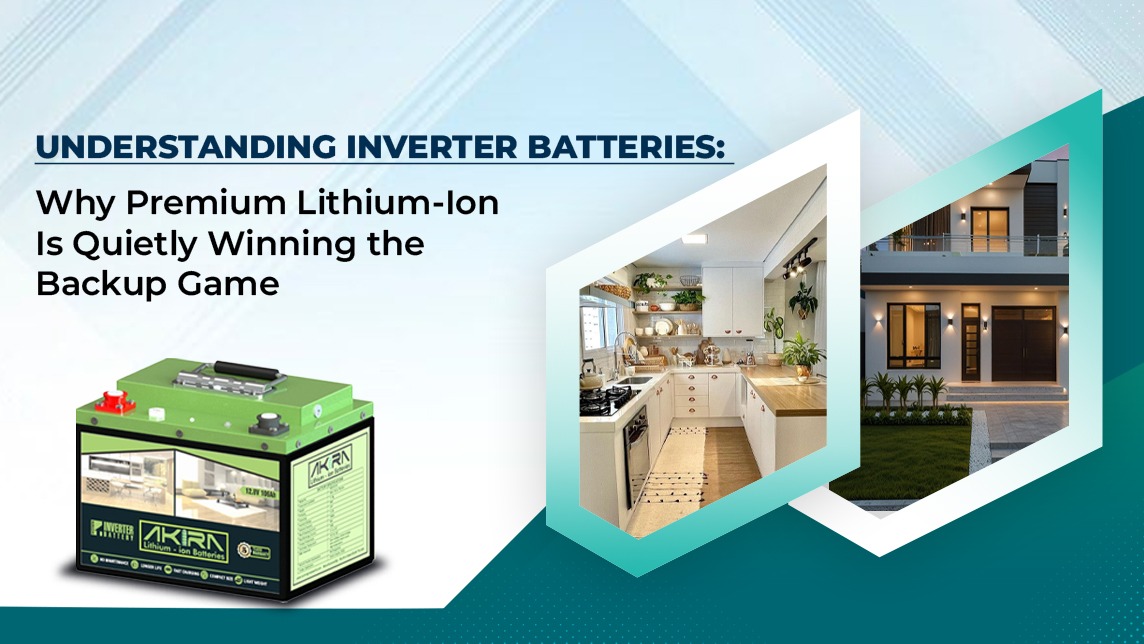
Understanding Inverter Batteries: Why Premium Lithium-Ion Is Quietly Winning the Backup Game

Power cuts still catch us off guard, don’t they? One minute everything’s fine, the next you’re scrambling for the inverter switch while the fan slows to a lazy stop. For years, most of us have relied on the same heavy, water-guzzling lead-acid batteries. They do the job. With Akira batteries, more families are making the switch to lithium-ion inverter batteries. Based on real usage patterns across Indian homes dealing with frequent voltage fluctuations and long summer outages, lithium-ion inverter batteries are proving to be a long-term upgrade, not a luxury. Let’s see in this blog how Lithium Ion Battery for Inverter is winning the backup game.

What Actually Feels Different Day-to-Day

A good lithium-ion battery for your inverter saves time and money. It offers many other benefits too.

Quick Comparison: Lead-Acid vs. Lithium-Ion for Inverters

  • Usable Power: Lead-acid: ~50% | Lithium-ion: 80–90%
  • Charging Time: Lead-acid: 6–10 hours | Lithium-ion: 2–4 hours
  • Maintenance: Lead-acid: Regular water top-ups | Lithium-ion: Less maintenance.
  • Typical Lifespan: Lead-acid: 4–5 years | Lithium-ion: 8–12 years

The Stuff You Stop Worrying About

Weight drops by half or more. Moving or repositioning the battery isn’t a two-person job that could result in a slipped disc. No more shining a torch into cells. No more trips to buy distilled water. No more cleaning corrosion every few months.

Lifespan follows the same logic. A well-cared-for lead-acid battery may last 4–5 years. In contrast, top lithium models often last 8–12 years with proper care and handle several thousand deep cycles. One lithium-ion battery for inverter can replace three conventional ones in ten years. They accumulate over time.

Efficiency feels good too. You lose far less energy going in and out of the battery, usually only 5–8% instead of 20% or worse. That small change leads to lower electricity bills. It also keeps things cooler during long backups.

Why Akira’s Approach Makes Sense Right Now

Akira lithium solutions for inverters are designed specifically for Indian power conditions. They handle voltage swings, heat over 45 °C, and the daily cycling that homes face. Our lithium batteries focus on inverters. They have strong built-in protection that stops damage before it starts. They recharge in a short time and fit snugly in tight utility spaces.

Many users say the same thing: they often forget about the battery. It only comes to mind during a power outage, which shows it’s still working well. That kind of quiet reliability is hard to put a price on.

Picking the Right One Without Overthinking It

Check your inverter first; most modern ones operate effectively with a lithium-ion battery for inverter after you adjust a couple of settings.

Capacity-wise, 100–200 Ah usually covers a typical 2–3 BHK nicely. Yes, the initial price tag looks higher. But when you factor in zero upkeep, deeper usable power, and years before the next replacement, the story changes.

Last Thought

You don’t buy inverter batteries because we love shopping for them. You buy them so the fridge keeps running, the Wi-Fi stays up for work calls, and the kids’ study table doesn’t turn into a candlelit zone.

A premium lithium ion battery for inverter, especially well-designed solutions like Akira’s, eliminates most of the old headaches and provides hours of reliable performance.

Ready for a smarter backup? Explore Akira’s lithium ion battery for inverter.

FAQs

Q1. Does a lithium ion battery for inverter really last that much longer?

Yes, most good ones give 8–12+ years or 3000–5000 cycles. That’s often 2–3× the real-world life of even a solid lead-acid.

Q2. Will my existing inverter work with lithium?

Usually yes, especially newer models. Just confirm the voltage settings and whether it supports lithium profiles. A quick call to the installer normally sorts it.

Q3. Are Akira batteries safe indoors?

They’re designed to be. Advanced BMS protection handles overcharge, deep discharge, temperature extremes, and short circuits, all built for Indian homes.
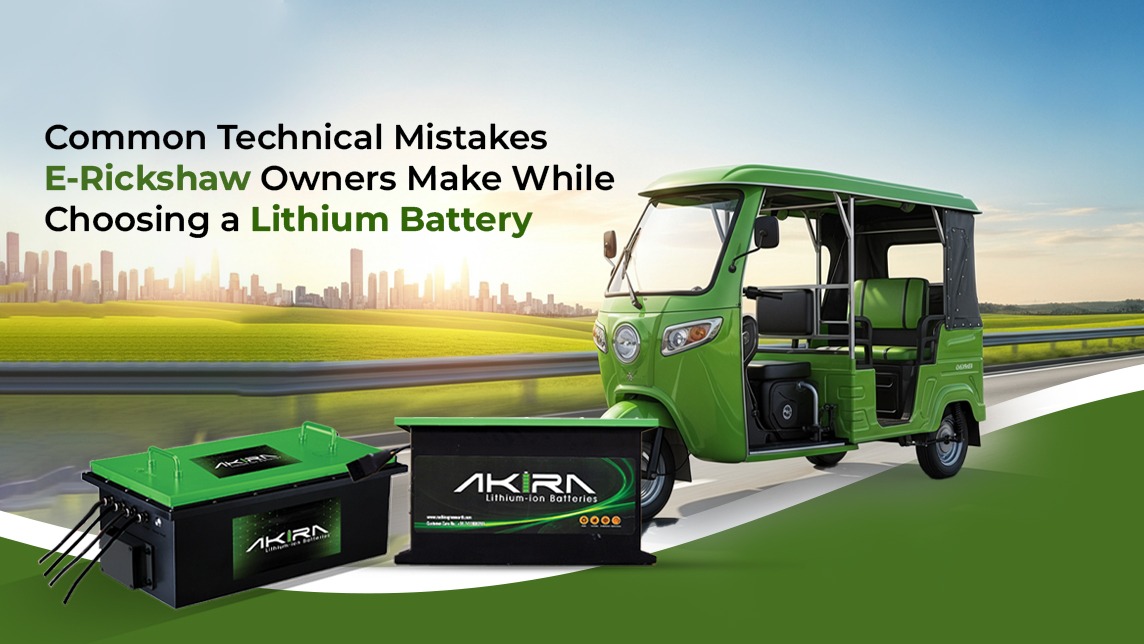
Common Technical Mistakes E-Rickshaw Owners Make While Choosing a Lithium Battery

In the e-rickshaw business, battery problems rarely appear overnight. They build quietly. A little voltage instability here. A bit of heating there. Then one day, range drops, controllers fail, or the battery simply refuses to hold charge. In most cases, the root cause isn’t usage, it’s selection.

Choosing the wrong lithium ion battery for e rickshaw from a technical standpoint is one of the costliest mistakes operators make. And unfortunately, it’s far more common than it should be.

1. Matching Nominal Voltage Without Studying Load Behaviour

On paper, voltage looks simple. In reality, it isn’t. Many batteries show the correct nominal voltage but collapse under real driving loads. That collapse stresses motor controllers and slowly damages internal components.

A properly engineered lithium ion battery for e rickshaw must hold voltage steady during acceleration, inclines, and stop-start traffic.

AKIRA batteries are designed to deliver controlled voltage behavior, not just a printed number on a label.

2. Confusing Capacity With Power Delivery

Capacity (Ah) is easy to sell. Power delivery is harder to explain and often ignored. When a battery is unable to deliver sufficient current during peak demand, voltage sag occurs. The rickshaw feels sluggish, heats up, and e-rickshaw battery drains faster than expected leading to reducing the life span of the battery.

AKIRA batteries are built with balanced discharge characteristics. That balance allows the lithium ion battery for e rickshaw to deliver power smoothly, even during continuous commercial use, without stressing the cells.

3. Ignoring Thermal Design in E-Rickshaw Lithium Batteries

Heat is the slowest, quietest battery killer. Poor thermal design doesn’t always cause immediate failure. Instead, it shortens battery life month by month.

AKIRA integrates thermal stability into the battery structure itself. Heat disperses evenly, temperatures remain controlled, and cell degradation slows dramatically. As a result, the lithium ion battery for e rickshaw performs consistently across long working hours and high ambient conditions.

4. Assuming All BMS Systems Are “Good Enough”

A weak Battery Management System doesn’t fail loudly. It fails silently, through poor cell balancing, delayed protection, and inaccurate charge readings.

AKIRA batteries use intelligent BMS logic that actively monitors voltage, current, and temperature at the cell level. This allows each lithium ion battery for e rickshaw to protect itself in real time, rather than reacting after damage has begun.

5. Using Unsuitable Lithium Cell Chemistry

Not every lithium chemistry belongs in a commercial EV. Some degrade quickly under repeated high-load cycles. Others lose stability when pushed daily.

AKIRA selects lithium chemistry specifically suited for e-rickshaw duty cycles. This ensures the lithium ion battery for e rickshaw maintains structural stability, predictable performance, and long service life under real operating conditions.

Why AKIRA Batteries Perform Reliably in the Field

AKIRA batteries are engineered around actual e-rickshaw usage, not lab assumptions. Voltage regulation, discharge capability, thermal control, and BMS intelligence work together as a single system. That systems approach is what delivers reliability, safety, and long-term value.

This engineering approach has been validated across diverse operating conditions and daily commercial usage.

Conclusion

Technical mistakes during battery selection rarely look serious at first. Yet over time, they reduce earnings, increase downtime, and raise replacement costs. Choosing a properly engineered lithium ion battery for e rickshaw eliminates these risks at the design level. AKIRA Batteries address the technical realities of commercial EV operation, making them a dependable choice for operators who value performance and longevity.

Avoid costly technical mistakes when choosing a battery for an e rickshaw. See how AKIRA Batteries ensure stable performance and longer life.

FAQs

Q1. Can poor thermal design reduce battery life without warning signs?

Yes. Heat accelerates internal degradation long before failure becomes visible.

Q2. Does BMS quality really affect daily driving?

Absolutely. A strong BMS ensures safety, balance, and accurate performance tracking.

Q3. Are AKIRA batteries suitable for high-usage e-rickshaws?

Yes. AKIRA batteries are engineered for continuous, high-load commercial operation.

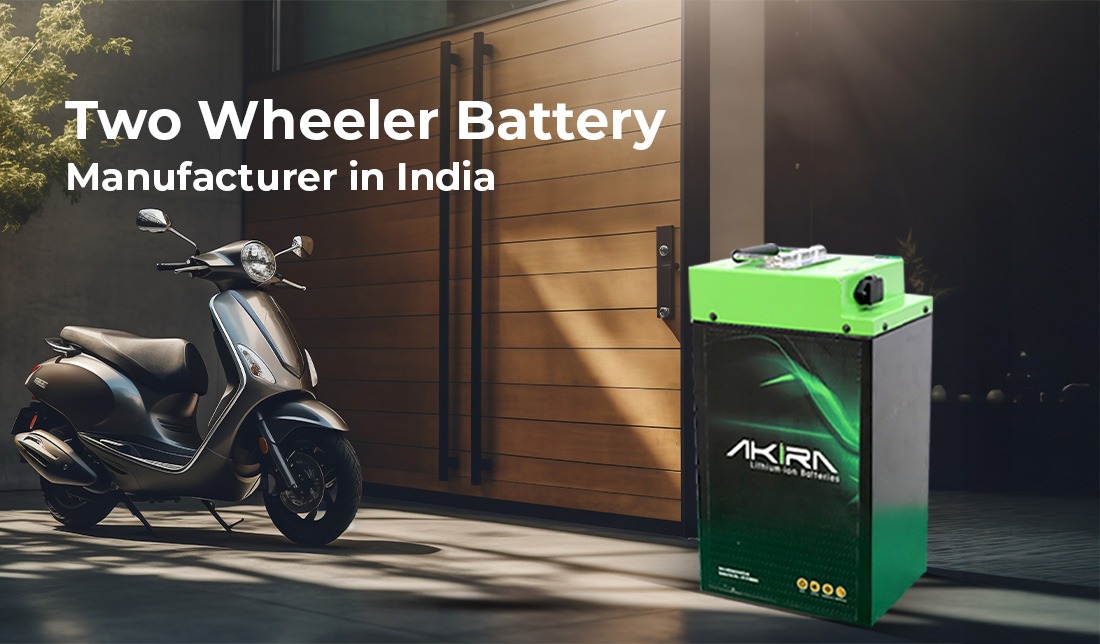
The Physics of Vibration: How Indian Roads Redefine Two-Wheeler Battery Durability

Indian roads tell a story. Sometimes smooth, often unpredictable, and always demanding. Every pothole, speed breaker, and uneven stretch sends vibrations straight through a two-wheeler’s frame. Riders feel it in their wrists. Batteries feel it inside their core. Most battery failures blamed on “poor quality” actually begin with vibration stress. Over time, these micro-shocks weaken internal components. Engineers at Akira have studied this closely. As a trusted Two wheeler battery manufacturer in India, Akira understands how road physics quietly decides battery lifespan.

Why Vibration Matters More Than You Think

Vibration is not just movement. It is repeated mechanical stress. When a scooter moves over rough terrain, energy transfers from the chassis into the battery casing. Inside, plates shift, weld joints strain, and electrolyte levels fluctuate.

Initially, performance feels normal. However, over thousands of kilometers, alignment drifts. Internal resistance increases. Eventually, starting power drops without warning.

Indian riding conditions amplify this effect. Urban traffic, rural roads, and overloaded rides create continuous low-frequency and high-frequency vibrations. Therefore, batteries designed for smoother environments struggle here. This is where a capable Two wheeler battery manufacturer in India makes a difference.

Internal Plate Damage: The Silent Breakdown

Battery plates store and release energy. They must remain stable. Under constant vibration, thin or poorly supported plates flex. Over time, active material sheds from the grid. Capacity declines.

Akira addresses this by using reinforced plate structures and optimized grid design. This ensures plates remain stable even under prolonged vibration exposure. Consequently, power delivery stays consistent for longer periods.

Electrolyte Imbalance and Vibration Stress

Vibration also affects electrolyte distribution. Repeated shaking causes uneven concentration. Some areas overwork, while others underperform. This imbalance accelerates sulfation and corrosion.

Akira batteries use precisely controlled electrolyte formulation and internal separators. As a result, chemical stability remains intact despite rough riding conditions. This attention to detail defines a responsible Two wheeler battery manufacturer in India.

Casing Strength: The First Line of Defense

A weak casing transfers vibration inward. A strong casing absorbs and disperses energy. Indian roads demand the latter.

Akira designs battery casings with vibration-resistant polymers and reinforced ribs. These features reduce internal shock transmission. Therefore, sensitive components remain protected even on long, uneven rides.

Real-World Riding Patterns Shape Durability

Stop-start traffic, sudden braking, heavy loads, and poor road surfaces combine into a harsh operating environment. Laboratory tests alone cannot predict this stress.

Akira tests batteries under simulated Indian road conditions. This approach ensures alignment between design and reality. It also explains why Akira earns trust as a Two wheeler battery manufacturer in India focused on durability, not just specifications.

How Engineering Converts Physics into Reliability

Battery longevity improves when physics guides design. Akira focuses on:

  • Reinforced internal plate support
  • Vibration-absorbing casing architecture
  • Stable electrolyte distribution
  • Secure terminal and weld structures

Each element works together. Consequently, vibration no longer shortens battery life prematurely.

Conclusion: Indian Roads Demand Smarter Batteries

Vibration never stops on Indian roads. It quietly reshapes battery durability every single day. However, when manufacturers engineer with this reality in mind, performance remains predictable.

Akira builds batteries that respect physics, road conditions, and rider expectations. Through focused engineering and field-tested design, Akira continues to stand strong as a dependable Two wheeler battery manufacturer in India.

Choose batteries engineered for real Indian roads. Discover Akira’s vibration-resistant two-wheeler batteries built for longer life and reliable performance

FAQs

Q1. Why do scooter batteries fail early on rough roads?

Continuous vibration damages internal plates, welds, and electrolyte balance over time.

Q2. Can vibration really affect starting power?

Yes. Internal damage increases resistance, reducing cranking performance..

Q3. Why choose Akira batteries?

Akira designs for Indian road realities, making it a reliable Two wheeler battery manufacturer in India focused on long-term durability.