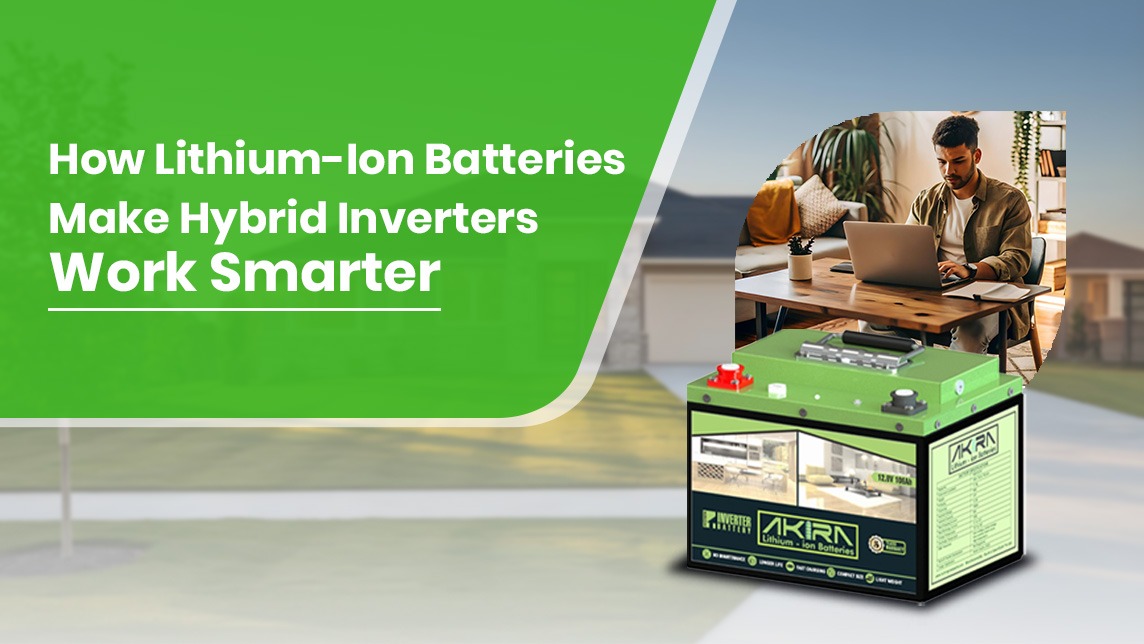
Over a period of time hybrid inverters have emerged as essential components in modern energy setups. They balance grid supply, renewable energy, and stored power. People notice when lights flicker or systems fail. But real efficiency often hides in a quieter place: the battery.
In recent years, lithium-ion inverter batteries have changed the norms a lot. They’re more than storage. They manage energy flow. They enhance system response. They also ensure everything runs smoothly for a long time. At Akira Batteries, we know a lithium ion battery for inverters isn’t just a part. It drives the whole system.
Efficiency Isn’t Just a Number
Most datasheets reduce efficiency to a percentage. But in reality, efficiency is about timing, response, and consistency.
If a battery struggles to deliver voltage or discharges unevenly, the inverter compensates. That compensation costs energy. Over time, it stresses components quietly. Lithium-ion batteries solve this problem at its source: steady voltage, fast response, and predictable behaviour let inverters breathe, not overwork.
Why Lithium-Ion Works Better Than Old Batteries
Traditional batteries were working efficiently earlier however, with modern progression their limitations began to highlight they were heavy, slow, and inconsistent. Voltage drops forced inverters to adjust constantly. Charging took longer, limiting flexibility. That created subtle energy losses across the system.
A lithium ion battery for inverters changes all that. It’s lighter, delivers voltage consistently, and charges efficiently. Inverters can switch seamlessly between solar, grid, and storage without hesitation. The whole system feels responsive. At Akira, we create these batteries to excel for months and years, not just in perfect lab settings.
Coordination Beats Raw Specs
Inverters rely on precision. When batteries behave unpredictably, control systems overcompensate. Heat rises, energy efficiency drops, components wear faster.
Akira Batteries focuses on coordination. Our lithium-ion batteries communicate clearly with the inverter’s control systems. That keeps power flow steady, voltage stable, and heat under control. Small efficiencies here add up over months, years even, preserving both energy and equipment.
Real-World Reliability: lithium ion battery for inverter
Energy systems rarely operate in perfect conditions. Heat, load fluctuations, and unstable grids are the norm. However, Lithium-ion batteries for inverters help your inverter thrive even under these conditions. They manage thermal stress, balance discharge, and keep hybrid inverters performing well.
Efficiency here isn’t a launch-day headline; it’s built to last. Akira tests for long-term performance, not short-term peaks.
Efficiency That Lasts
There is a long period of sustainability associated with lithium-based energy storage systems. It is known that the lifespan of lithium-ion batteries is stable and easy to forecast.
With a lithium-ion battery, an inverter will function properly for many, many years without experiencing any sort of unanticipated decrease in efficiency.
So that all other batteries manufactured by Akira will experience, as a result of Akira’s design and development process, a reduced amount of maintenance, consistent aging, and the ability to perform uniformly at high efficiency for the entire lifespan of the batteries.
Conclusion
Hybrid inverters are only as efficient as the batteries behind them. Lithium-ion batteries deliver fast response, stable output, and reliable long-term performance.
Akira Batteries provides lithium ion battery for inverter solutions designed for sustained efficiency, coordination, and durability. In hybrid systems, efficiency isn’t a claim, it’s lived every day.
FAQ
Q1. Why is battery–inverter coordination critical?
Poor coordination generates heat and inefficiency. Proper alignment ensures steady power and longer component life.
Q2. Are lithium ion battery for inverter suitable for continuous use?
Yes. They maintain output, manage thermal stress, and perform predictably over thousands of cycles.
Q3. Why choose Akira Batteries for inverter systems?
Akira emphasizes real-world testing, lifecycle efficiency, and precise system-level reliability rather than short-term specs.