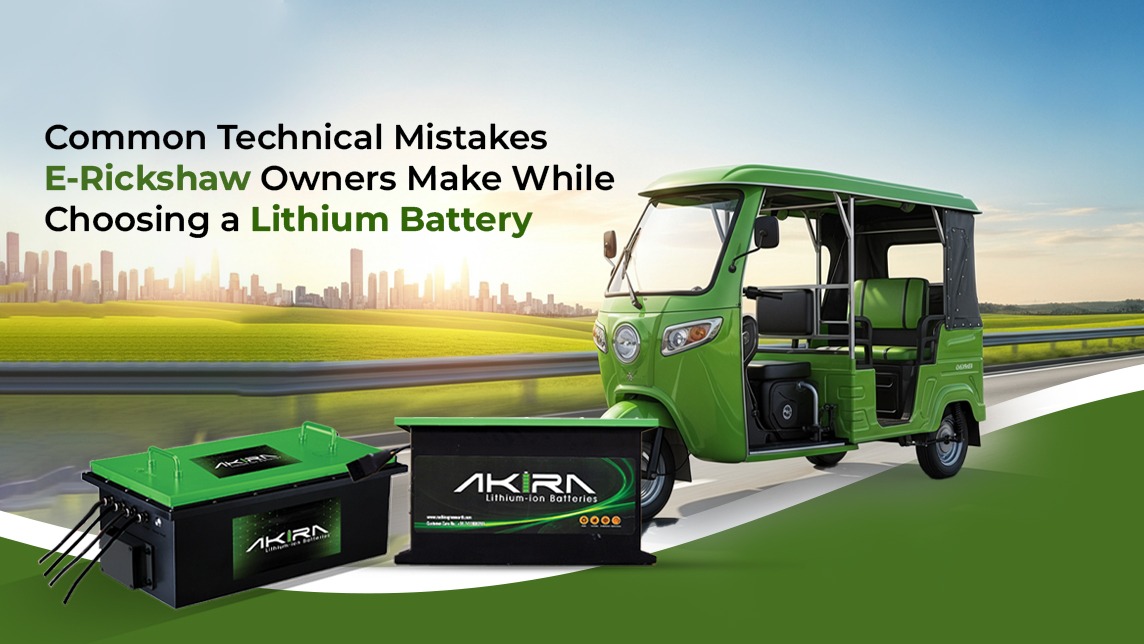
In the e-rickshaw business, battery problems rarely appear overnight. They build quietly. A little voltage instability here. A bit of heating there. Then one day, range drops, controllers fail, or the battery simply refuses to hold charge. In most cases, the root cause isn’t usage, it’s selection.
Choosing the wrong lithium ion battery for e rickshaw from a technical standpoint is one of the costliest mistakes operators make. And unfortunately, it’s far more common than it should be.
1. Matching Nominal Voltage Without Studying Load Behaviour
On paper, voltage looks simple. In reality, it isn’t. Many batteries show the correct nominal voltage but collapse under real driving loads. That collapse stresses motor controllers and slowly damages internal components.
A properly engineered lithium ion battery for e rickshaw must hold voltage steady during acceleration, inclines, and stop-start traffic.
AKIRA batteries are designed to deliver controlled voltage behavior, not just a printed number on a label.
2. Confusing Capacity With Power Delivery
Capacity (Ah) is easy to sell. Power delivery is harder to explain and often ignored. When a battery is unable to deliver sufficient current during peak demand, voltage sag occurs. The rickshaw feels sluggish, heats up, and e-rickshaw battery drains faster than expected leading to reducing the life span of the battery.
AKIRA batteries are built with balanced discharge characteristics. That balance allows the lithium ion battery for e rickshaw to deliver power smoothly, even during continuous commercial use, without stressing the cells.
3. Ignoring Thermal Design in E-Rickshaw Lithium Batteries
Heat is the slowest, quietest battery killer. Poor thermal design doesn’t always cause immediate failure. Instead, it shortens battery life month by month.
AKIRA integrates thermal stability into the battery structure itself. Heat disperses evenly, temperatures remain controlled, and cell degradation slows dramatically. As a result, the lithium ion battery for e rickshaw performs consistently across long working hours and high ambient conditions.
4. Assuming All BMS Systems Are “Good Enough”
A weak Battery Management System doesn’t fail loudly. It fails silently, through poor cell balancing, delayed protection, and inaccurate charge readings.
AKIRA batteries use intelligent BMS logic that actively monitors voltage, current, and temperature at the cell level. This allows each lithium ion battery for e rickshaw to protect itself in real time, rather than reacting after damage has begun.
5. Using Unsuitable Lithium Cell Chemistry
Not every lithium chemistry belongs in a commercial EV. Some degrade quickly under repeated high-load cycles. Others lose stability when pushed daily.
AKIRA selects lithium chemistry specifically suited for e-rickshaw duty cycles. This ensures the lithium ion battery for e rickshaw maintains structural stability, predictable performance, and long service life under real operating conditions.
Why AKIRA Batteries Perform Reliably in the Field
AKIRA batteries are engineered around actual e-rickshaw usage, not lab assumptions. Voltage regulation, discharge capability, thermal control, and BMS intelligence work together as a single system. That systems approach is what delivers reliability, safety, and long-term value.
This engineering approach has been validated across diverse operating conditions and daily commercial usage.
Conclusion
Technical mistakes during battery selection rarely look serious at first. Yet over time, they reduce earnings, increase downtime, and raise replacement costs. Choosing a properly engineered lithium ion battery for e rickshaw eliminates these risks at the design level. AKIRA Batteries address the technical realities of commercial EV operation, making them a dependable choice for operators who value performance and longevity.
Avoid costly technical mistakes when choosing a battery for an e rickshaw. See how AKIRA Batteries ensure stable performance and longer life.
FAQs
Q1. Can poor thermal design reduce battery life without warning signs?
Yes. Heat accelerates internal degradation long before failure becomes visible.
Q2. Does BMS quality really affect daily driving?
Absolutely. A strong BMS ensures safety, balance, and accurate performance tracking.
Q3. Are AKIRA batteries suitable for high-usage e-rickshaws?
Yes. AKIRA batteries are engineered for continuous, high-load commercial operation.